
Introduction
NextEra Energy is the world's largest generator of renewable energy from the wind and sun and a world leader in battery storage. NextEra is the parent company of Florida Power & Light Company, America's largest electric utility, and NextEra Energy Resources, LLC, a competitive clean energy business.
*Although many project details are confidential, I’m happy to discuss my experience in more detail during a conversation upon request.
Overview
Making Enterprise AI More Intuitive, Trusted, and Actionable
Redesigned and helped shape Version 2.0 of NEE.AI, an enterprise AI tool used across NextEra Energy. NEE.AI was developed before employees had access to tools like ChatGPT and Microsoft Copilot within a secure enterprise environment. The platform was created to help teams begin leveraging AI and LLM’s while ensuring company data and information remained protected through enterprise-level security and governance. This effort focused on improving adoption, reducing onboarding friction, and creating workflows that supported both novice and advanced AI users. The redesign led to a significant increase in user satisfaction and reduced barriers to integrating AI into daily work.
The Problem
Strong AI Capabilities, but Low User Adoption
The initial launch of NEE.AI showed strong organizational potential, but adoption was slower than anticipated.
Key challenges included:
Confusing and disorienting interface patterns
Workflows that did not align with real employee behaviors
High cognitive load and heavy reliance on user recall
Limited guidance for onboarding and feature discovery
Difficulty balancing the needs of beginner and advanced AI users
As enterprise interest in AI accelerated, the product needed to evolve into a scalable, intuitive, and trusted internal platform employees could confidently incorporate into everyday workflows.
Key Insights

Before 2.0 Redesign

Users Needed Clarity, Confidence, and Simpler Paths to Value
Version 2.0 transformed NEE.AI into a more approachable, scalable, and workflow-oriented AI experience.
The redesigned experience:
Reduced friction for first-time users
Created clearer pathways for task completion
Improved discoverability of AI capabilities
Supported broader enterprise adoption
Enabled users to integrate AI more naturally into daily routines
The platform evolved from a technically capable tool into a more human-centered product experience designed around real employee behaviors and needs.
The Reflection
My Role
Contributing to the Experience Design of Enterprise AI Adoption
Senior Experience Architect
I partnered closely with Engineers, Product Managers, Stakeholders across the enterprise, end users, and internal teams
My responsibilities included:
Leading UX strategy and experience design for Version 2.0
Designing and facilitating cross functional team workshop to define the North Star vision and experience principles.
Synthesizing user feedback and behavioral insights
Creating workflows, wireframes, and high-fidelity prototypes
Conducting usability testing and iterative design refinement
Aligning user needs with business and technical constraints
Designing scalable patterns that supported future AI feature growth

Design / Strategy Actions
Redesigning the Experience Around Real Employee Workflows
Simplified the core experience:
Redesigned the homepage and primary workflows to reduce cognitive overload
Created clearer entry points into the platform
Improved onboarding and feature education:
Introduced more intuitive navigation, progressive disclosure, and contextual guidance to help users understand capabilities without overwhelming them.
Designed for layered user maturity: Created experiences that supported both,
Beginner users seeking straightforward workflows
Advanced users wanting deeper functionality and customization
Grounded decisions in research and iteration:
Analyzed Version 1.0 feedback and usage patterns
Conducted stakeholder interviews
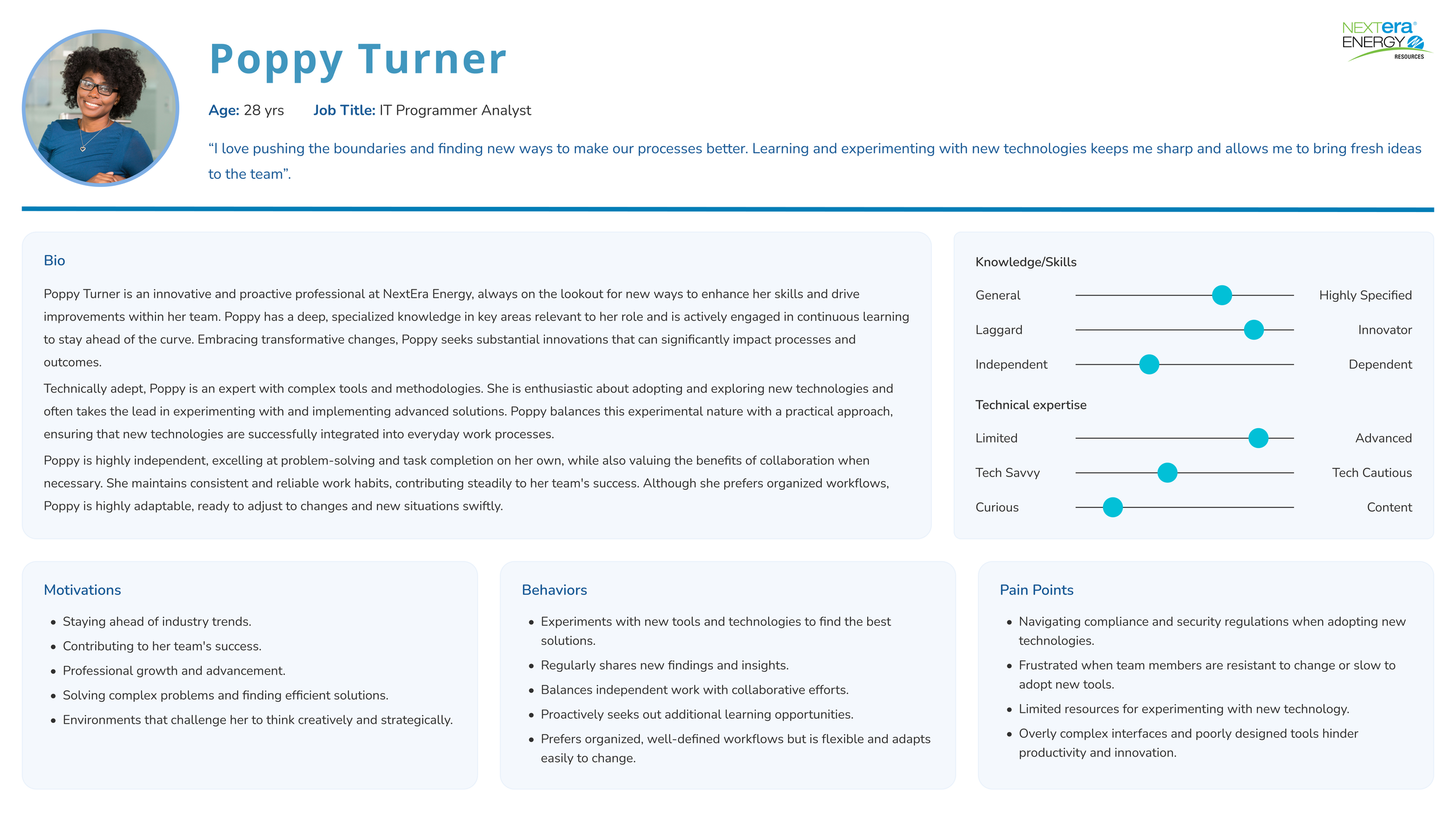
Developed personas to align product decisions with user needs
Tested prototypes and iterated based on usability findings
Collaborated cross-functionally
Worked closely with engineering and product teams to balance usability improvements with technical feasibility and enterprise security requirements.
The Solution
Transforming NEE.AI into a Scalable, Human-Centered AI Platform
Research and feedback synthesis revealed several recurring themes:
Users needed clearer onboarding and guidance: Many employees were unfamiliar with AI tooling and lacked confidence in how to use the platform effectively within their daily work.
Simplicity increased trust and usability: The initial experience introduced too much complexity too quickly. Reducing visual and workflow clutter helped users feel more comfortable engaging with the tool.
Different user types required different levels of depth: Basic users wanted quick, guided workflows, while advanced users wanted flexibility and access to more powerful capabilities.
Users struggled with feature discoverability: Important functionality existed, but users often did not know where to find it or how it could help them.
The Impact
Lowering the Barrier to Support Adoption Across the Enterprise
Usability & Adoption
User satisfaction increased from 55% to 80%
Qualitative feedback indicated a significantly lower barrier to entry
Users reported a more intuitive onboarding experience
User Behavior Improvements
Increased confidence among first-time AI users
Improved discoverability of key features
More seamless integration into daily workflows
Business Impact
Supported broader enterprise AI adoption initiatives
Helped position AI tooling as more accessible and practical for employees
Created a scalable UX foundation for future product growth
Designing AI Experiences People Actually Want to Use
This project reinforced the importance of designing enterprise AI experiences around human behavior, not just technical capability. One of the biggest lessons was recognizing that successful AI adoption depends as much on clarity, trust, and onboarding as it does on functionality itself.